The Business Research Company’s Hardware, ADAS, Telematics Global Market Report 2026 – Market Size, Trends, And Forecast 2026-2035
LONDON, GREATER LONDON , UNITED KINGDOM, October 16, 2026 /EINPresswire.com/ — The predictive vehicle technology market is rapidly gaining traction as automotive manufacturers and tech companies race to harness AI, telematics, and real-time data analytics. This sector is becoming a crucial battleground where innovation in hardware, software, and connectivity converges to enhance vehicle efficiency, safety, and uptime. Let’s explore its market dynamics, key drivers, leading players, and emerging trends shaping the future of connected mobility.
Projected Market Size and Growth Trajectory for Predictive Vehicle Technology
The predictive vehicle technology market is anticipated to surpass $110 billion by 2030, growing at a strong compound annual growth rate (CAGR) of 19%. This segment represents a significant portion of the broader Artificial Intelligence market, which is forecasted to reach nearly $920 billion by the same year, with predictive vehicle technology contributing about 12% of that total. When viewed in the context of the Information Technology sector—expected to hit $13,788 billion by 2030—this market accounts for close to 1% of the overall value.
Request A Free Sample Of The Predictive Vehicle Technology Market Report
https://thebusinessresearchcompany.com/sample_request?id=52141703&type=smp&name=Predictive%20Vehicle%20Technology%20Market%20Report%202026&utm_source=EINPresswire&utm_medium=Paid&utm_campaign=Oct_PR
North America’s Leading Role in Predictive Vehicle Technology Demand
North America is set to dominate the predictive vehicle technology landscape, reaching a market value of $40 billion in 2030, up from $18 billion in 2025, with an 18% CAGR. This growth is driven by widespread adoption of connected vehicle systems, AI-powered predictive analytics in transport, vehicle health monitoring integration, and increasing investments in smart mobility infrastructure. The region’s emphasis on real-time driving data and efficient fleet management plays a pivotal role in fueling this expansion.
The United States Powers Growth Within North America
Within North America, the United States will lead the charge with a projected market size of $35 billion by 2030, more than doubling from $15 billion in 2025 at an 18% CAGR. Key factors behind this surge include advancements in software-defined vehicles, predictive diagnostics that reduce downtime, the expansion of connected car platforms from domestic automakers, growing demand for intelligent transport services, cloud-based vehicle data processing, and continuous refinement of predictive algorithms aimed at enhancing reliability and user experience.
Access The Detailed Predictive Vehicle Technology Market Report Here
https://thebusinessresearchcompany.com/report/predictive-vehicle-technology-global-market-report?utm_source=EINPresswire&utm_medium=Paid&utm_campaign=Oct_PR
Hardware Segment Dominates Predictive Vehicle Technology Market Share
Hardware components, including advanced sensors, electronic control units, and high-performance in-vehicle computing systems, will account for the largest share of the predictive vehicle technology market in 2030—36%, or approximately $40 billion. This segment benefits from improvements in edge computing for real-time analytics, connectivity modules that support predictive functionalities, and semiconductor innovations that boost data accuracy and processing efficiency.
Diverse Market Segmentation by Vehicle, Deployment, and Application
The predictive vehicle technology market also breaks down into several key segments: by vehicle type (passenger and commercial vehicles), by deployment model (on-premise and cloud), and by application (proactive alerts, safety and security, maintenance analysis, and predictive smart parking). These categorizations reflect the broad range of use cases and technological approaches driving the market forward.
Factors Fueling Rapid Expansion in Predictive Vehicle Technology
One major growth catalyst is the widespread adoption of connected telematics. Automakers and fleet operators increasingly rely on telematics platforms to collect real-time data, monitor vehicle performance, and optimize operational decisions. Enhanced connectivity and cloud infrastructure enable continuous data streaming for analytics, improving transport management for both passenger and commercial vehicles. This driver contributes roughly 2.6% to the market’s annual growth rate.
Artificial intelligence and machine learning (AI/ML) applied by original equipment manufacturers (OEMs) also play a crucial role. These technologies help detect anomalies, predict component failures, and schedule maintenance proactively, thus maximizing vehicle uptime and extending life cycles. Investment in intelligent software platforms accelerates adoption, adding about 2.4% to yearly market growth.
Additionally, regulatory pressures focused on vehicle safety are encouraging adoption of predictive technologies. Governments and transportation agencies promote systems that prevent accidents, monitor vehicles, and enhance driver awareness. Compliance with stricter safety standards favors predictive platforms capable of analyzing vehicle behavior and flagging potential risks, contributing approximately 2.1% growth annually.
AI-powered Safety Innovations Define Emerging Market Trends
AI-driven automotive safety solutions are becoming game-changers in predictive vehicle technology by enabling real-time fault detection and facilitating proactive maintenance. For example, in January 2024, Infineon Technologies AG and Aurora Labs introduced an AI-powered automotive safety system that detects software anomalies and forecasts failures in critical vehicle components before they cause disruptions. This system enhances functional safety, helps meet regulatory demands, and improves overall vehicle performance and security.
Tesla Inc. Leads Global Sales in Predictive Vehicle Technology
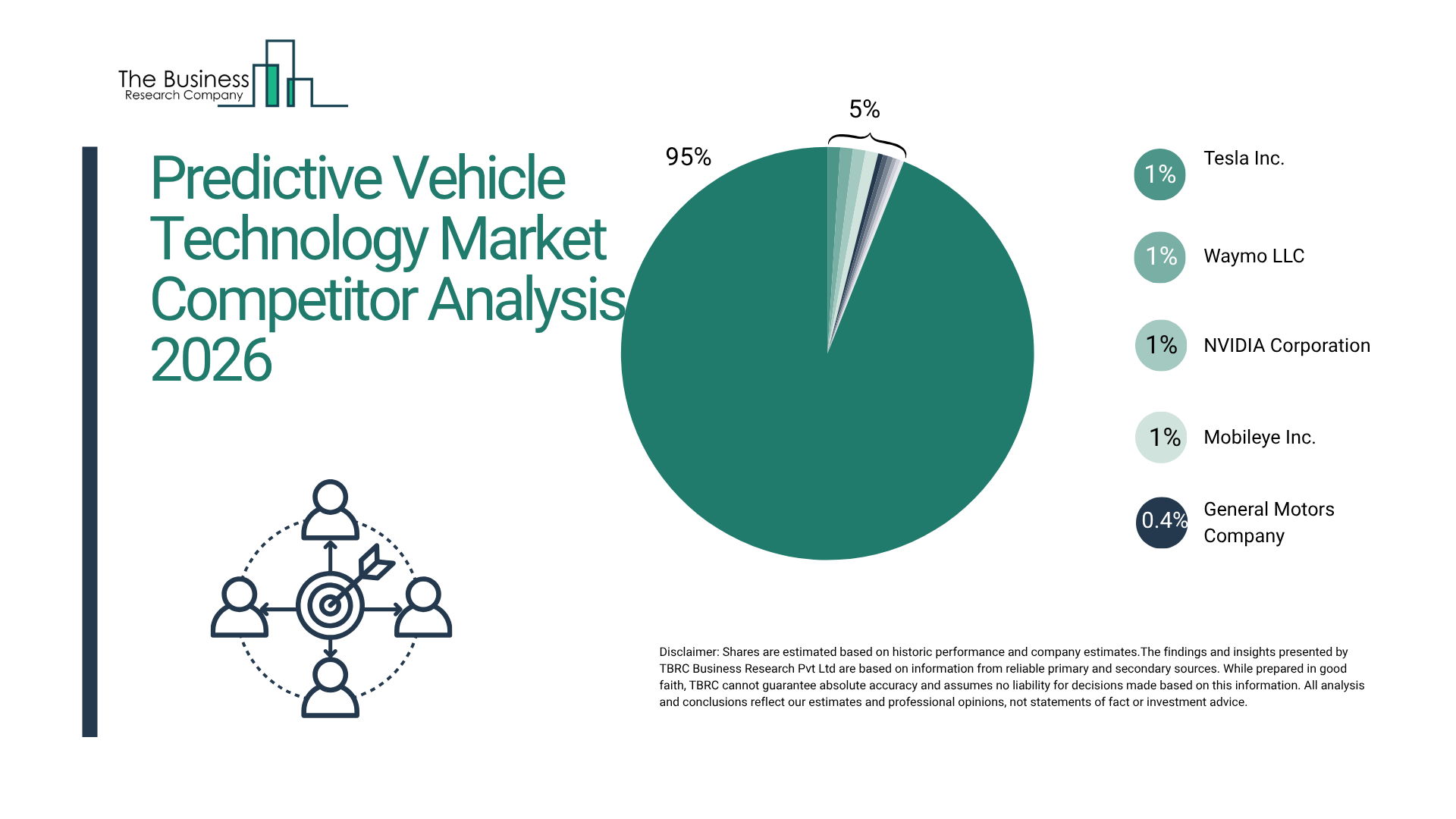
Tesla held a 1% share of the global predictive vehicle technology market in 2024, according to The Business Research Company. Its strength lies in connected vehicle software, over-the-air update infrastructure, onboard computing capabilities, AI analytics, and real-time fleet data platforms. These enable predictive maintenance, performance optimization, operational intelligence, and advanced driver assistance primarily for passenger vehicles.
Key Players Steering the Predictive Vehicle Technology Market
The market features numerous influential companies, including Tesla, Inc., Waymo LLC, NVIDIA Corporation, Mobileye Inc., General Motors Company, Qualcomm Incorporated, Toyota Motor Corporation, Mercedes-Benz Group AG, Ford Motor Company, Hyundai Motor Company, Baidu, Inc., Aptiv PLC, ZF Friedrichshafen AG, Honda Motor Co., Ltd., Bayerische Motoren Werke AG, NXP Semiconductors N.V., Volvo Group, Stellantis N.V., SAIC Motor Corporation Limited, Nuro, Inc., and Aurora Innovation, Inc.
Market Fragmentation and Competitive Landscape
Despite significant investment in connected vehicle technologies, AI, autonomous driving, and data analytics, the predictive vehicle technology market remains fragmented. The top ten companies accounted for only 5% of total revenue in 2024. These leaders maintain their positions through proprietary software, extensive vehicle data networks, advanced computing infrastructure, and strategic collaborations spanning mobility and technology sectors. As demand grows for predictive intelligence, connected services, autonomous features, and real-time optimization, ongoing technological innovation and ecosystem expansion will likely bolster their market presence.
Top Market Shares Held by Leading Companies in 2024
The 2024 market revenue shares for top companies were distributed as follows: Tesla Inc., Waymo LLC, NVIDIA Corporation, Mobileye Inc., and General Motors Company each held 1%; Qualcomm Incorporated, Toyota Motor Corporation, and Mercedes-Benz Group AG each accounted for 0.4%; while Ford Motor Company and Hyundai Motor Company each captured 0.3%.
Competitive Strategies Among Industry Leaders
Leading companies compete by leveraging AI-powered predictive analytics to enhance vehicle reliability and performance. They integrate sophisticated telematics for real-time vehicle intelligence, deploy cloud-based platforms to optimize fleet monitoring, form strategic partnerships to accelerate connected mobility ecosystems, and invest heavily in edge computing technologies to advance predictive maintenance and safety.
Value Addition Forecast in Predictive Vehicle Technology by 2030
From 2025 to 2030, hardware, ADAS, telematics, and OBD will collectively add over $63 billion in market value. Hardware alone will contribute $23 billion, ADAS $17 billion, telematics $14 billion, and OBD $9 billion. This growth stems from intelligent sensing and computing platforms, real-time vehicle data processing, connected mobility technologies, and predictive analytics that elevate efficiency and vehicle performance—hallmarks of the automotive industry’s shift toward data-driven mobility.
Supply Chain Participants and End Users in the Predictive Vehicle Technology Market
Raw material suppliers include industry giants like Taiwan Semiconductor Manufacturing Company (TSMC), Samsung Electronics, SK hynix, Micron Technology, NVIDIA, Qualcomm, Infineon Technologies, STMicroelectronics, Renesas Electronics, Texas Instruments, Analog Devices, ON Semiconductor, GlobalFoundries, Murata Manufacturing, Rohm, ams-OSRAM, TE Connectivity, Keysight Technologies, Corning, Foxconn, Jabil, and Celestica.
Wholesalers and distributors supporting the market comprise Arrow Electronics, Avnet, WPG Holdings, TD SYNNEX, Ingram Micro, Richardson Electronics, Macnica Holdings, Rutronik Elektronische Bauelemente, DigiKey, Mouser Electronics, RS Group, Farnell Global, TTI, Heilind Electronics, Sager Electronics, Redington Limited, Westcon-Comstor, Exclusive Networks, and ScanSource.
End users deploying predictive vehicle technology include Tesla, Waymo, Mobileye, General Motors, Toyota, Mercedes-Benz, Ford, Hyundai, Baidu, Aptiv, ZF Friedrichshafen, Honda, BMW Group, Volvo Group, Stellantis, SAIC Motor, Nuro, and Aurora Innovation.
This comprehensive landscape illustrates the vibrant ecosystem driving advances in predictive vehicle technology, positioning it as a key pillar in the future of connected and intelligent transportation.
Our 2026 reports feature deeper market intelligence with market attractiveness scoring and analysis, total addressable market (TAM) analysis, company scoring matrix graphics and tables, Excel-based forecasting dashboards, market hotspots infographics, key technologies and future trend analysis, and updated graphics and tables.
Learn More About The Business Research Company
The Business Research Company (www.thebusinessresearchcompany.com) is a leading market intelligence firm renowned for its expertise in company, market, and consumer research. We have published over 30,000+ reports across 27 industries and 60+ geographies. Our research is powered by 1,500,000 datasets, extensive secondary research, and exclusive insights from interviews with industry leaders.
We provide continuous and custom research services, offering a range of specialized packages tailored to your needs, including Market Entry Research Package, Competitor Tracking Package, Supplier & Distributor Package and much more.
Disclaimer: Please note that the findings, conclusions and recommendations that TBRC Business Research Pvt Ltd delivers are based on information gathered in good faith from both primary and secondary sources, whose accuracy we are not always in a position to guarantee. As such TBRC Business Research Pvt Ltd can accept no liability whatever for actions taken based on any information that may subsequently prove to be incorrect. Analysis and findings included in TBRC reports and presentations are our estimates, opinions and are not intended as statements of fact or investment guidance.
Contact Us:
The Business Research Company
Americas +1 310-496-7795
Europe +44 7882 955267
Asia & Others +44 7882 955267 & +91 8897263534
Email: marketing@tbrc.info
Follow Us On:
LinkedIn: https://in.linkedin.com/company/the-business-research-company.
Oliver Guirdham
The Business Research Company
+44 7882 955267
info@tbrc.info
Visit us on social media:
LinkedIn
Facebook
X
Legal Disclaimer:
EIN Presswire provides this news content “as is” without warranty of any kind. We do not accept any responsibility or liability
for the accuracy, content, images, videos, licenses, completeness, legality, or reliability of the information contained in this
article. If you have any complaints or copyright issues related to this article, kindly contact the author above.

Media gallery