
Key Takeaways
- Restaurant technology often involves several companies, but no single company may take responsibility for the complete setup.
- An apparent POS problem may involve incoming internet, the restaurant’s internal network or the POS installation and support team.
- Backup internet can protect against certain provider or power interruptions, but it cannot correct poor internal wiring or incomplete installation.
- A POS solution should be evaluated by the quality of its installation, programming, training and ongoing support—not only its features or price.
- Louis Ramirez helps restaurant owners understand their options and connect with qualified providers rather than attempting to perform every technical service himself.
A restaurant can purchase a modern point-of-sale system and still experience recurring technology problems.
The terminal may be new. The software may be cloud-based. The restaurant may have fast internet. Yet payments can still stall, handheld devices can lose connectivity, printers can stop receiving orders and online ordering can become unreliable.
The larger problem is often not one product. It is the lack of coordination between the different companies involved.
When Every Provider Handles Only One Piece
A typical restaurant technology environment may involve:
- An internet service provider
- A modem or router
- Ethernet cables and network switches
- Wi-Fi access points
- A POS company
- A payment processor
- Kitchen printers or display systems
- Online ordering services
- Delivery platforms
- Security cameras and other connected equipment
Each provider may be responsible for only one part.
When a problem occurs, the internet provider may confirm that service is reaching the building. The POS company may confirm that its software is operating. The installer may no longer be involved.
The restaurant owner is then left between several companies, trying to determine who should take responsibility.
Restaurant profitability advisor Louis Ramirez believes this fragmented structure represents a larger industry problem.
“Restaurant owners should not have to become IT professionals simply because they purchased a POS system,” Ramirez said. “Technology is only as good as the companies and people standing behind it.”
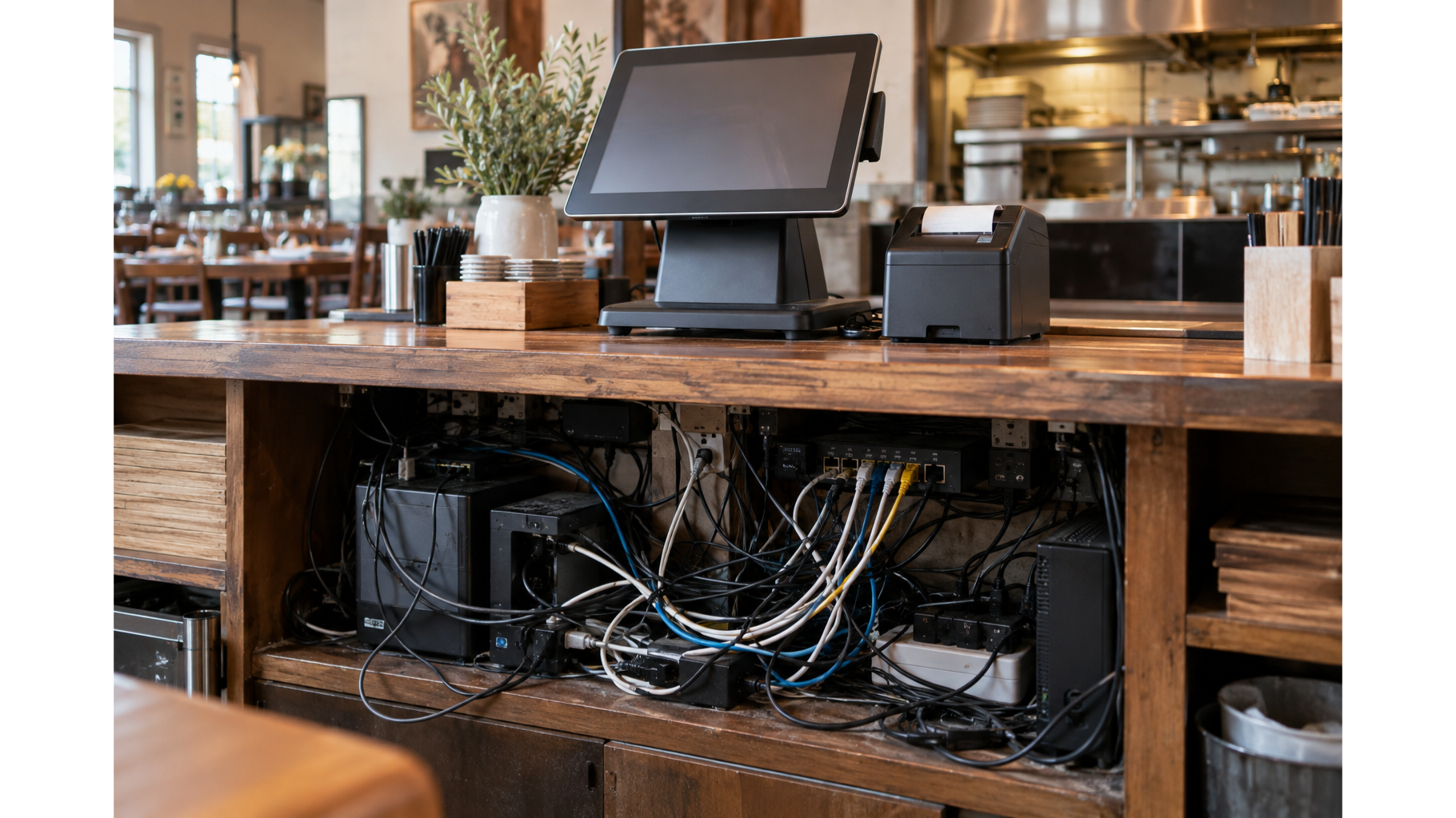
The “Spaghetti Setup” Behind the POS
Over time, different vendors may install terminals, printers, switches, power supplies, access points, payment devices and delivery equipment.
New cables are added, while older cables may remain in place. Equipment may not be labeled. Staff members may not know which connection controls which system.
Ramirez calls this the restaurant’s “spaghetti setup.”
The phrase describes more than wiring that looks disorganized. It represents a restaurant technology environment assembled by multiple providers without one clear plan or accountable support structure.
A faster internet plan cannot repair poor internal wiring. New Ethernet cables cannot protect the restaurant from an outside internet outage. A new POS terminal cannot automatically correct everything underneath it.
The solution begins with understanding the different responsibilities involved.
Three Areas That Must Work Together
Restaurant technology reliability generally depends on three connected areas.
1. Incoming Internet and Backup Connectivity
The internet service provider delivers connectivity to the restaurant. When that service is interrupted, cloud-based systems, online ordering and connected payment functions may be affected.
Automatic backup connectivity may help protect the restaurant during certain provider or power interruptions.
One current example is Spectrum Business Invincible WiFi. Spectrum states that eligible customers can automatically switch to 5G backup within approximately 15 to 30 seconds after a detected internet or power interruption.
Spectrum also advertises WiFi 7 and an included battery providing up to eight hours of backup power. Availability, cellular coverage, speeds, battery performance and service terms vary.
Backup connectivity is valuable when the incoming connection fails. It does not repair internal wiring, switches or equipment placement inside the restaurant.
2. The Internal Restaurant Network
After internet service enters the building, the connection must reach the equipment that uses it.
That internal network may include Ethernet cables, switches, routers and Wi-Fi access points. Specialized network or installation professionals should evaluate and correct problems within this area.
Ramirez does not position himself as the person who personally repairs every cable or configures every network device. His role is to help the restaurant owner recognize that the problem may require a qualified connectivity or installation provider rather than another product purchase.
3. POS Installation, Training and Support
A POS system should be judged by more than its software features and processing rate.
Restaurant owners should also evaluate:
- Who installs the equipment
- Who prepares the necessary cabling
- Who programs the menu
- Who trains the restaurant team
- Who supports the system after installation
- Who responds when something stops working
Depending on the restaurant, selected solution and qualification requirements, available implementation services may include Ethernet cabling, equipment installation, menu programming, employee training, online ordering, website support and ongoing on-site assistance.
The provider performing those services is responsible for the technical work. Ramirez helps the restaurant owner evaluate the available solution and make the appropriate connection.
The Consultant’s Role
Local Restaurant Owner was created to give independent restaurant owners a clearer starting point.
Ramirez begins by learning what the owner is experiencing and what outcome the restaurant needs. He then helps separate the problem into the appropriate category.
When incoming internet reliability is the concern, Ramirez can refer the owner to alocal business connectivity specialist who can evaluate available Spectrum Business options.
When the restaurant needs a properly supported POS and payments solution, Ramirez can help identify options backed by teams that provide installation, programming, training and ongoing support.
Sometimes the right recommendation may be to keep the restaurant’s existing service or equipment.
The purpose is not to force every restaurant into a new internet plan, POS system or processing relationship. The purpose is to help the owner avoid buying another disconnected product without understanding who will implement it and stand behind it.
Diagnose the Business Problem Before Selecting the Provider
Restaurant owners do not need to know how to repair every technical problem. They need to know which qualified company should be responsible for solving it.
That is the gap Ramirez seeks to fill.
“Sometimes the restaurant does not need another product,” Ramirez said. “It needs someone to look at the complete situation, explain the options and connect the owner with the right team.”
More information about restaurant POS connectivity and the consultant-led process is available at LocalRestaurantOwner.com.
Restaurant owners evaluating internet, POS, payments or implementation options can request a no-cost initial consultation.
Bring More Clients
info@bringmoreclients.com
+17145535819
14071 Peyton Dr.
Unit 1232
Chino Hills
CA
91709
United States


