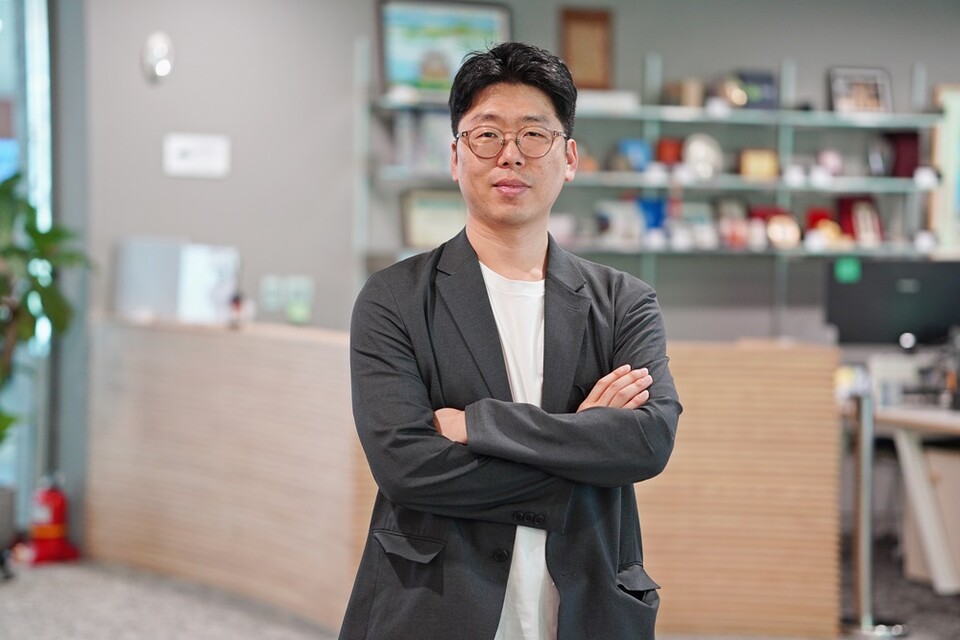
“Our Platform Eliminates Hotel Renovation Costs with Curated Art Rooms and Revenue-Sharing Showrooms for Independent Hotels Worldwide.”
PANGYO, GYEONGGI-DO, SOUTH KOREA, September 16, 2026 /EINPresswire.com/ — A hospitality content platform company is captivating travelers worldwide by transforming conventional, standardized hotel rooms into experiential art rooms—termed “IP Rooms”—infused with art and local culture. That company is DIVE IN GROUP, which has established its base at Pangyo Techno Valley Startup Campus. Grounded in partnerships with domestic and overseas hotels, DIVE IN presents a new paradigm in the accommodation market by revamping 2- to 4-star business and local hotels into showrooms imbued with the distinct identities of artists, brands, and local cultures.
CEO Chang-yun Jeong, who led the founding of DIVE IN, pioneered the business as a real estate developer, cultural arts director, and runway fashion show director, bridging gaps between disparate industries and creating new value. While operating two art stays and a complex cultural space in Yeonnam-dong, Seoul, Jeong recognized a critical limitation: the extreme scarcity of offline channels where talented creators could regularly connect with audiences. Concurrently, unlike 5-star properties, most 2- to 4-star hotels lacked dedicated content planning teams and struggled to differentiate themselves amid room aging and price competition. Jeong connected these two challenges, conceptualizing hotel rooms as art content channels.
The greatest strength of DIVE IN’s business model is that hotels bear zero upfront investment costs. DIVE IN operates on a risk-taking model, fully pre-investing in all necessary expenses for room development—including initial planning, spatial design, art curation, and construction. Subsequently, it adopts a revenue-sharing structure that splits proceeds generated from room bookings alongside sales of internal artworks and merchandise with the hotel. In particular, DIVE IN collaborates directly with artists to manage the maintenance and operational oversight of murals and artworks—a major concern for hotel operators—completely alleviating burdens on property owners.
This innovative journey began in earnest in 2022 with the renovation of three vacant rooms at a hotel in Insa-dong, Seoul. By remodeling less desirable rooms that had columns limiting spatial utility or were used for storage, room rates increased from 70,000–80,000 KRW to 120,000–130,000 KRW while maintaining high occupancy rates. Furthermore, all artworks and decorative objects placed in the rooms sold out within three months, proving supplementary retail profitability. Building on this momentum, DIVE IN has grown steadily and now operates approximately 120 art rooms across eight hotels nationwide.
DIVE IN’s business is expanding rapidly beyond South Korea into global markets. Overseas expansion kicked off in 2023 when a hotel owner in Morocco reached out via Instagram DM to propose a collaboration. Jeong flew to the site and, alongside 11 artists, successfully created four art rooms in the Moroccan hotel themed around Korea’s four seasons—subsequent partnerships followed with hotels in Hanoi, Vietnam, and Bangkok, Thailand. Currently, DIVE IN operates approximately 150 rooms across 11 hotels in South Korea, Morocco, Vietnam, and Thailand, aiming to expand its footprint to 250 rooms by next year. Recently, by broadening communications with second-generation hotel managers, the company has been actively discussing partnerships and entering new markets such as the Philippines, Singapore, and the United States.
Beyond guest rooms, hosting regular pop-up exhibitions and art events in hotel lobbies and communal spaces at no cost is another distinctive strategy of DIVE IN. Through this, artists gain continuous offline distribution channels, while hotels elevate their brand image without incurring expenses. Having established a hub for global expansion in Pangyo Techno Valley, DIVE IN is advancing technical optimizations—including system stabilization and booking platform integrations—in collaboration with top-tier technology companies in Pangyo to leap from a simple lodging provider into a global art retail shopping destination operating 24/7.
Pangyo TV met with DIVE IN Group CEO Chang-yun Jeong at the Startup Campus in Pangyo Techno Valley to discuss their hotel-room IP model, zero-cost hospitality partnerships, art-retail monetization, and global expansion strategy. Reporter Thomas Frederiksen conducted the interview.
Q1. Thomas Frederiksen, Reporter: Hello, my name is Thomas, and thank you so much for joining us here today for another great interview at the Pangyo Startup Campus. I’m here with Chang-yun Jeong, CEO of DIVE IN Group. Welcome! Could you tell us a bit about DIVE IN Group and what your company does?
A. Chang-yun Jeong, CEO of DIVE IN Group: Hotels are typically classified into 5-star luxury properties or global chains, but the 2- to 4-star tier mostly consists of local independent hotels. DIVE IN Group partners with these local hotels to help them maximize their profitability. We co-invest with hotels to transform guest rooms into unique, art-driven spaces, then co-market and sell those rooms to dramatically boost revenue.
Q2. What inspired you to start this business, and what core challenges in the hospitality and art markets did you set out to solve?
A. Chang-yun Jeong: Local hotels desperately want differentiation. Five-star and global luxury chains have dedicated in-house content and creative teams, whereas 2- to 4-star local hotels typically do not. They focus solely on general sales and facility operations and are often unsure how to stand out. Recognizing that gap, we stepped in to act as their external content team, offering co-investment to solve that challenge together. On the creative side, emerging artists and indie lifestyle brands struggle to find effective platforms to showcase their work to the public. We proposed creating hotel guest rooms together to serve as living, experiential showrooms. Young consumers often seek unique art and design experiences, and as hotels saw occupancy and booking rates rise, this evolved into a sustainable business model.
Q3. Why is a long-term, co-investment strategy so crucial compared to standard temporary pop-ups?
A. Chang-yun Jeong: Short-term pop-ups or one-off events can temporarily raise awareness, but for artists, they can feel transactional or exploitative if they don’t build long-term equity. That is why we sign long-term contracts with partner hotels spanning 3 to 5 years. This provides emerging artists and boutique brands with a stable, multi-year showroom where we continuously support operations, marketing, and sales. We co-invest upfront because if the hotel demands fees and the artist also demands upfront compensation, nothing moves forward. By taking the financial risk and investing first, we align everyone’s interests for sustainable, long-term growth.
Q4. How did your personal background lead to structuring the business this way?
A. Chang-yun Jeong: Before founding DIVE IN Group, I worked at a real estate development firm and directed arts and cultural productions—managing concert planning, Seoul Cultural Foundation projects, and stage directing for fashion shows. I noticed that real estate developers and creative artists speak completely different languages, have different priorities, and hold different business perspectives. To bridge that gap, someone had to take on the risk, so we decided to take that risk ourselves. In return, we negotiated full creative authority over content curation, artist selection, and room design from the hotels. For the artists, we provide production budgets on the condition that they create customized, exclusive works tailored specifically to the space rather than bringing in existing inventory, driving occupancy, art sales, and shared revenue.
Q5. How do you address hotel owners’ operational and maintenance concerns regarding unique, non-standardized rooms?
A. Chang-yun Jeong: Because travelers have diverse tastes, each guest room is curated with a completely distinct artistic concept. Most hotels avoid design diversity because standardized rooms are easier to manage and maintain. We address their operational concerns directly: by taking on the investment, we also take full responsibility for maintenance. If an artwork or mural is damaged, our team and the artist repair and restore it at no extra burden to the hotel staff. This reassurance gives hotels the confidence to partner with us.
Q6. How did your expansion progress from your initial three pilot rooms in Seoul to international properties?
A. Chang-yun Jeong: We started in 2022 at a hotel in Insa-dong, Seoul, with just three rooms that were previously hard to sell or used for storage. We renovated those rooms, increased the nightly rate from around 70,000–80,000 KRW to 120,000–130,000 KRW, and achieved significantly higher occupancy rates. On top of that, all artwork and design objects on display sold out within three months! Because we share both booking revenue and art-sale profits with the hotel, the owner generated additional ancillary revenue while elevating the property’s brand image. Our global expansion started in 2023 when a hotel owner in Morocco reached out via Instagram DM. We partnered with 11 Korean artists to design four rooms themed around Korea’s four distinct seasons. Following that, we expanded to Hanoi, Vietnam, and Bangkok, Thailand. Currently, we operate approximately 150 rooms across 11 hotels in Korea, Morocco, Vietnam, and Thailand, aiming to expand to around 250 rooms by next year.
Q7. What trends are you seeing in overseas hospitality markets, and how are you expanding into global art retail?
A. Chang-yun Jeong: In international markets, many hotel properties are transitioning to second-generation owners who studied hospitality abroad. These owners seek innovative concepts and have approached us to collaborate. We are currently in active discussions for projects in the Philippines, Singapore, Vietnam, and the United States. We view our business not simply as hotel operations, but as a global retail and showroom distribution platform. All custom artworks, furniture, and design objects inside the rooms are available for purchase, generating meaningful revenue for both artists and hotel owners. We also curate free exhibitions in lobbies and common lounges, and partner with convention centers to set up mock room installations to reach wider audiences.
Q8. Finally, what are the key advantages of basing your operations here at the Pangyo Startup Campus?
A. Chang-yun Jeong: As we expand globally, digital systems—such as integrated booking engines and PMS synchronization—have become critical. Being based in Pangyo allows us to directly connect and collaborate with various tech and software companies, helping us strengthen our technological infrastructure alongside our creative content.
Kim Seung Yeon
Gyeonggi Business & Science Accelerator
+82 31-776-4834
email us here
Visit us on social media:
LinkedIn
Instagram
Facebook
YouTube
Other
How This Korean Startup Turns Boring Hotel Rooms into Cash-Generating Art Galleries!
Legal Disclaimer:
EIN Presswire provides this news content “as is” without warranty of any kind. We do not accept any responsibility or liability
for the accuracy, content, images, videos, licenses, completeness, legality, or reliability of the information contained in this
article. If you have any complaints or copyright issues related to this article, kindly contact the author above.

Media gallery