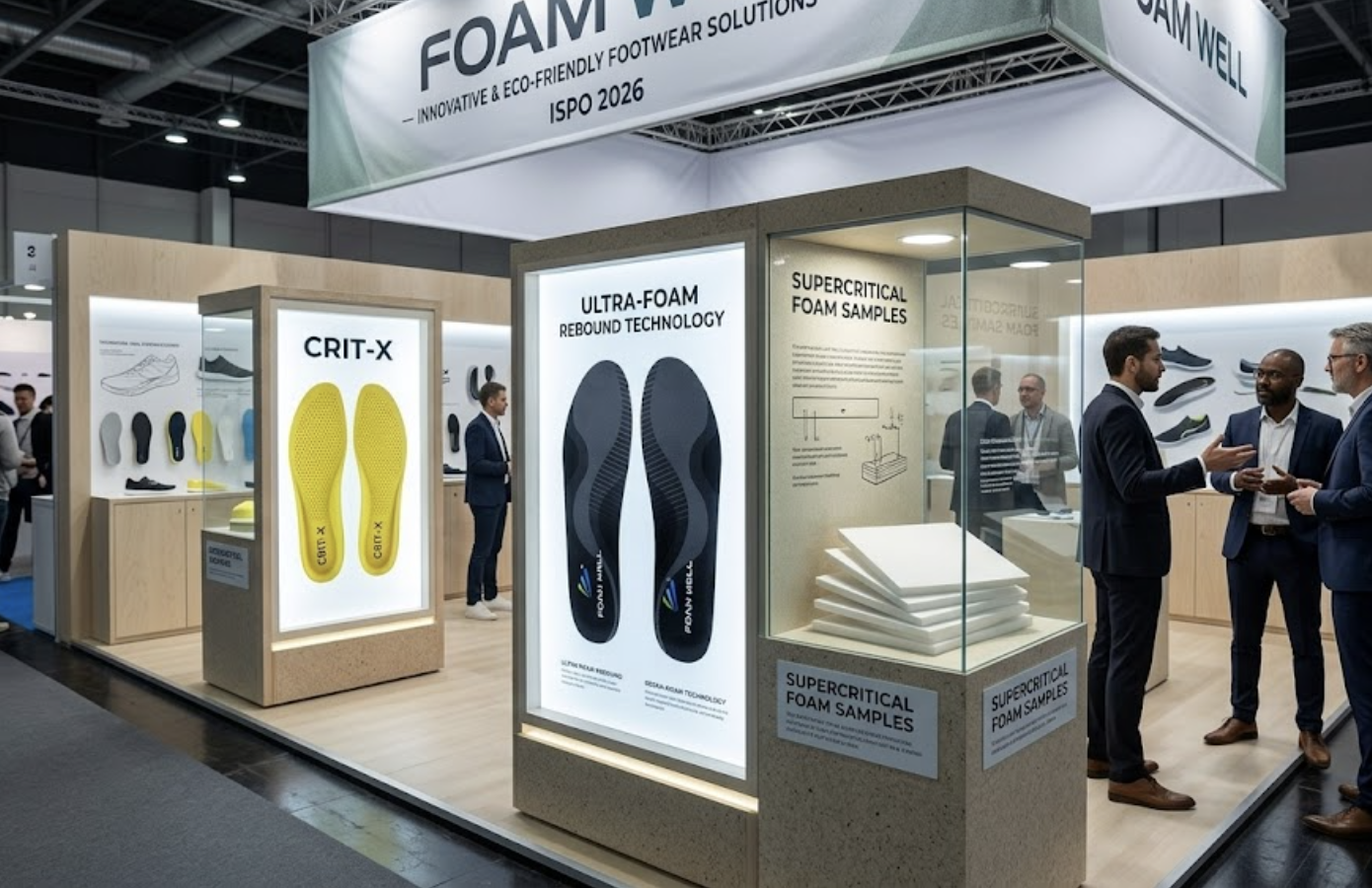
DONGGUAN, GUANGDONG, CHINA, August 24, 2026 /EINPresswire.com/ — At ISPO 2026, one of the sporting goods industry’s key sourcing events, Foamwell presented a lineup of high-rebound insole solutions built on its supercritical foaming platform. The centerpiece of the display was the High-Rebound Insole line, engineered to combine lightweight cushioning with consistent energy return for athletic and everyday footwear applications. Buyers examining the booth encountered not a single product but a technology pathway: a supercritical foam material developed over several years of internal R&D, now translated into finished insoles ready for production.
The exhibit reflected a broader shift underway in footwear component sourcing. Brands increasingly evaluate suppliers not by isolated SKUs but by the underlying material science that supports an entire product family. Foamwell’s approach at ISPO 2026 made that logic visible on the show floor, tracing a line from raw foam formulation to two distinct finished products designed for different performance needs.
From Supercritical Foam to Finished Insole
Supercritical foaming relies on nitrogen or carbon dioxide combined with polymers under controlled pressure, producing a cellular foam structure without chemical blowing agents. Foamwell markets this material internally as SCF Activ10, a supercritical POE foam with a density range of roughly 0.07D to 0.08D and thickness options spanning 1 to 100 millimeters. The process avoids the toxic byproducts common to traditional chemical foaming, a distinction that carries weight for buyers auditing production methods rather than simply reading marketing claims.
That base material feeds two separate insole products, each built for a different use case. The CRIT-X Insole pairs a breathable mesh top layer with a CRIT-X foam base, delivering lightweight support and shock absorption suited to general athletic and casual footwear. Its contoured design promotes foot alignment and distributes pressure evenly across the sole, addressing fatigue during extended wear rather than short bursts of activity alone.
The LEAP E60 Insole with Supercritical EVA takes a narrower performance focus. Built with a supercritical EVA base rated at 60 percent rebound, it targets running and cross-training applications where energy return during repetitive impact matters more than general-purpose comfort. Both products share breathable mesh construction and a common material lineage, yet the density and rebound characteristics diverge enough to serve distinct footwear categories without forcing brands into a one-size-fits-all component.
Questions From the Sourcing Floor
Conversations at the booth centered less on enthusiasm and more on verification. Sourcing teams walking the floor tend to ask pointed, practical questions, and this year’s exhibit was no exception. Buyers asked how rebound performance holds up across production batches, a fair question given that foam density can drift without tight process control. They asked about certification support for markets with strict safety or labor compliance requirements, referencing Foamwell’s ISO9001, BSCI, SGS, and GRS certifications as reference points rather than assumptions. Sample lead times also came up frequently; Foamwell quotes roughly 35 days from payment to sample delivery, a figure that matters directly to brands working against seasonal launch calendars.
These questions matter because rebound percentage alone does not tell a sourcing manager whether a material will perform reliably at scale. Consistency, documentation, and lead time collectively determine whether a promising material sample becomes a viable production order. Foamwell’s presentation appeared structured around answering exactly those questions rather than around generating booth traffic for its own sake.
Turning Material Science Into Custom Orders
Foamwell, registered in Hong Kong with production facilities across China, Vietnam, and Indonesia, positions its custom solution service as the mechanism connecting show-floor interest to actual purchase orders. Brands can specify logo placement, material composition, thickness, size, and color, adapting the SCF Activ10 platform to insoles for running shoes, training footwear, or everyday comfort lines without starting material development from scratch. This customization layer explains why the ISPO showcase functioned as a technical conversation rather than a simple product unveiling: the underlying platform is flexible enough to support multiple footwear categories from a shared material base.
For smaller or mid-sized footwear brands, this flexibility carries practical significance. Developing a proprietary foam formulation from the ground up requires capital and time that many brands cannot justify for a single insole line. Working from an established supercritical platform shortens that development cycle considerably, letting a brand focus resources on footwear design while relying on an established manufacturer for the underlying material engineering.
Sustainability Metrics, Not Just Language
Environmental claims surrounding foam materials often draw skepticism from procurement teams accustomed to vague sustainability language. The supercritical foaming process underlying SCF Activ10 offers a more concrete basis for evaluation. Because the process eliminates chemical additives typically required in conventional foam production, it reduces both toxic byproducts and the associated environmental risk during manufacturing. The material also carries GRS certification, providing third-party verification rather than a self-reported claim, and Foamwell describes the resulting foam as recyclable with a comparatively low carbon footprint.
For sourcing teams operating under increasingly strict environmental disclosure requirements from retailers and regulators alike, this distinction matters. A certified, chemically simplified foaming process gives brands documentation they can pass along their own supply chain, rather than a marketing statement that raises more questions than it answers.
What the Show Signals Going Forward
The ISPO 2026 exhibit suggests a sourcing environment where footwear brands consolidate supplier relationships around adaptable material platforms instead of individual components. Foamwell’s presentation, built around a single supercritical foam base extended into multiple finished products, aligns with that direction. Combined with a stated production capacity of roughly 28 million pairs annually and a customer base spanning more than 150 countries, the company’s positioning at the show reflects an attempt to serve both the technical scrutiny of sourcing teams and the scale requirements of established footwear brands.
Whether this approach gains further traction will depend on how consistently the material performs once orders move from sample to mass production, a question that show-floor conversations alone cannot fully answer. For now, the technical questions raised at ISPO 2026 and the documentation Foamwell offered in response indicate a supplier oriented toward sourcing teams that expect substantiated claims rather than broad performance assurances.
Additional information on Foamwell’s insole and foam material offerings is available at https://www.foam-well.com/.
Foamwell Limited
Foamwell Limited
+ +86 13549380132
email us here
Legal Disclaimer:
EIN Presswire provides this news content “as is” without warranty of any kind. We do not accept any responsibility or liability
for the accuracy, content, images, videos, licenses, completeness, legality, or reliability of the information contained in this
article. If you have any complaints or copyright issues related to this article, kindly contact the author above.

Media gallery