MtoZ Biolabs provides PhIP-Seq analysis support for antigen epitope screening, antibody repertoire profiling, autoantibody discovery, and biomarker research.
BOSTON, MA, UNITED STATES, June 21, 2026 /EINPresswire.com/ — Which antigens are recognized by antibodies present in a given sample? Are there unknown autoantibodies or disease-associated antibody reactivity signals? Do antibody responses exhibit identifiable differential patterns across disease states, treatment stages, or immune exposure histories? Methods such as ELISA, western blotting, immunofluorescence, and protein microarrays remain valuable for validating known targets. However, when the candidate antigen space is broad, the antibody targets are not yet clearly defined, or antibody response differences need to be compared across large sample cohorts, single-target or low-throughput assays are often insufficient. To better support antibody response repertoire research, high-throughput antigen and candidate linear epitope screening, and the discovery of candidate disease-associated immune signals, MtoZ Biolabs has launched a PhIP-Seq platform, providing systematic PhIP-Seq analysis service support for researchers.
What Is PhIP-Seq?
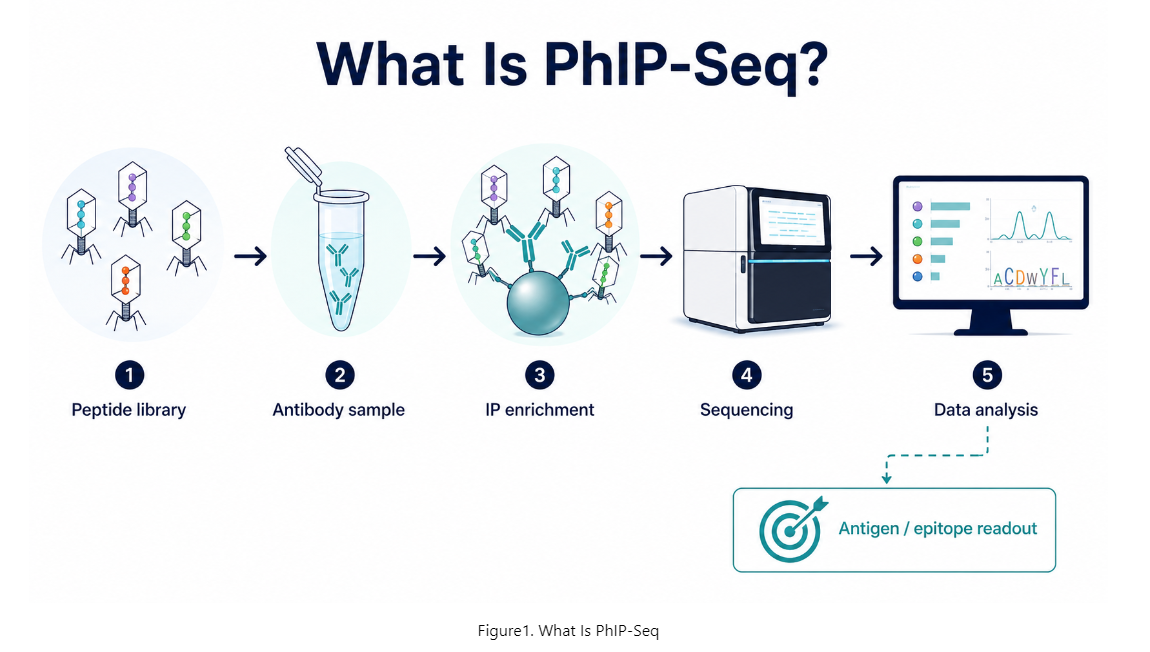
PhIP-Seq is a high-throughput technology for analyzing antibody binding to phage-displayed antigen-derived peptides by integrating phage-displayed peptide libraries, antibody immunoprecipitation, and high-throughput sequencing. The core principle is to display large numbers of antigen-derived peptides on the surface of phages and then incubate these peptide-displaying phages with antibody-containing biofluid samples, such as serum, plasma, or cerebrospinal fluid. Antibody-recognized phages are subsequently enriched through immunoprecipitation, and their encoded DNA sequences are analyzed by high-throughput sequencing. This process enables the inference of candidate antigens or candidate linear epitopes associated with antibody binding in the sample.
How Does the PhIP-Seq Platform Support High-Throughput Antigen Epitope Screening?
High-throughput antigen epitope screening is one of the major application areas of PhIP-Seq technology. Conventional antigen screening typically requires researchers to predefine candidate proteins or candidate epitopes before validating them individually. In studies of autoimmune diseases, complex infections, tumor-associated immune abnormalities, or exposure to multiple pathogens, the number of candidate antigens may be extremely large, making comprehensive screening difficult to complete efficiently using traditional methods alone.
The key value of the PhIP-Seq platform lies in its ability to analyze, in a single experiment, the binding relationships between large numbers of antigen-derived peptides and antibodies in the tested samples. By rationally designing phage-displayed peptide libraries, researchers can define screening scopes that match different scientific questions. For example,
In autoimmune disease research, human proteome-related peptide libraries or autoimmune-associated epitope libraries can be selected;
In infection immunology research, viral, bacterial, fungal, or pathogen-specific antigen libraries can be selected;
In vaccine research, peptide libraries can be designed based on vaccine-related antigens or pathogen-derived proteins to evaluate changes in antibody response repertoires before and after immunization.
PhIP-Seq Workflow
1. Clarify research objectives and sample grouping
Different projects require different experimental design strategies. For example, autoimmune disease studies commonly focus on differential antibody reactivity between patient groups and healthy control groups. Vaccine studies often evaluate changes in antibody responses before and after vaccination or across different immunization strategies. Infection immunology studies may focus on differences in antibody repertoires associated with pathogen exposure, infection stage, or disease severity.
2. Select or design an appropriate phage-displayed antigen peptide library
The antigen peptide library determines the antigenic space covered by PhIP-Seq and directly affects the interpretability of candidate findings. If the research objective is to screen for unknown autoantibodies, broader human-derived protein libraries or autoimmune-associated antigen libraries are typically required. If the objective is to analyze antibody responses against a specific pathogen, pathogen-associated antigen peptide libraries are more appropriate.
3. Enrichment of antibody-bound phage-displayed peptides and high-throughput sequencing analysis
Biofluid samples are then co-incubated with the phage-displayed peptide library, allowing antibodies in the samples to bind their corresponding antigen peptides. After immunoprecipitation enrichment, the retained phage particles represent the collection of antigen peptides recognized by sample antibodies. Following DNA amplification and high-throughput sequencing of the enriched products, the workflow proceeds to data analysis, including peptide read count calculation, enrichment signal normalization, inter-sample comparison, candidate antigen screening, and visualization analysis.
What Should Be Considered Before Conducting PhIP-Seq Research?
1. Whether the sample type is suitable
PhIP-Seq is generally suitable for antibody-containing biofluid samples, including serum, plasma, and cerebrospinal fluid. Antibody abundance, background components, and storage conditions may vary across different sample types. Therefore, before sample submission, standardized sample storage should be ensured as much as possible, while repeated freeze-thaw cycles and obvious contamination should be avoided.
2. Whether the study groups are clearly defined
PhIP-Seq is frequently used for inter-group comparisons. Therefore, the grouping design among patient groups, control groups, pre- and post-treatment samples, pre- and post-vaccination samples, or different disease subtypes is critical. If the grouping logic is unclear, the biological significance of the resulting antibody recognition data may be difficult to interpret, even when large datasets are generated.
3. Whether the antigen peptide library matches the research objective
Different antigen peptide libraries define different screening ranges. Human-derived protein antigen libraries are more suitable for autoantibody and autoimmune-related studies; pathogen antigen libraries are more appropriate for infection exposure and pathogen immunology research; allergen antigen libraries are more suitable for allergy-related antibody analysis; and customized antigen peptide libraries are appropriate for studies centered on specific proteins, pathogens, or research hypotheses.
4. Whether the results require subsequent validation
PhIP-Seq is a high-throughput discovery-oriented technology. Candidate antigens or candidate linear epitopes identified through screening should not be regarded directly as final conclusions. Candidate findings with potential diagnostic, mechanistic, or functional significance should be further validated using independent experimental methods.
5. Whether the data analysis strategy has been planned in advance
Statistical thresholds, background subtraction, batch-effect control, sample size design, and visualization methods can all influence candidate signal screening. For complex projects, it is recommended to define the primary comparison groups, core analytical indicators, and downstream validation strategy before the experiment begins.
MtoZ Biolabs PhIP-Seq Platform
To support PhIP-Seq-related research needs, MtoZ Biolabs has established a PhIP-Seq platform that provides technical support for universities, research institutes, and biopharmaceutical companies. The platform can be applied to high-throughput antigen epitope screening, antibody response repertoire analysis, autoantibody screening, pathogen antibody repertoire analysis, vaccine immune evaluation, and disease-associated antigen discovery.
1. During the project design stage
MtoZ Biolabs can assist in evaluating sample types, study grouping, and antigen peptide library selection strategies according to the research objective. For projects with clearly defined research targets, MtoZ Biolabs can provide customized antigen peptide library design recommendations based on target proteins, pathogens, species backgrounds, or disease areas. For exploratory research projects, suitable ready-to-use antigen libraries can also be recommended according to application scenarios, helping researchers improve screening efficiency.
2. During the testing and analysis stage
MtoZ Biolabs can provide support for sample testing, phage display sequencing assays, sequencing data processing, peptide enrichment analysis, candidate antigen screening, result visualization, and customized bioinformatics analysis. These services help researchers extract candidate signals with stronger interpretive value from complex antibody repertoire datasets.
Conclusion
By combining phage-displayed peptide libraries, immunoprecipitation, and high-throughput sequencing, PhIP-Seq extends traditional single-target antibody detection into systematic antibody response repertoire research. PhIP-Seq can be applied to high-throughput antigen and candidate linear epitope screening, autoantibody discovery, infection immunology analysis, vaccine evaluation, and candidate disease-associated antigen research. Researchers are welcome to contact MtoZ Biolabs to discuss sample type, study grouping, sample size, and research objectives, so that an appropriate PhIP-Seq analysis plan can be further evaluated.
Media Contact
Name: Prime Jones
Company: MtoZ Biolabs
Email: marketing@mtoz-biolabs.com
Phone: +1-857-362-9535
Address: 155 Federal Street, Suite 700, Boston, MA 02110, USA
Country: United States
Website: https://www.mtoz-biolabs.com
Prime Jones
MtoZ Biolabs
+1 857-362-9535
marketing@mtoz-biolabs.com
Visit us on social media:
Facebook
YouTube
X
Legal Disclaimer:
EIN Presswire provides this news content “as is” without warranty of any kind. We do not accept any responsibility or liability
for the accuracy, content, images, videos, licenses, completeness, legality, or reliability of the information contained in this
article. If you have any complaints or copyright issues related to this article, kindly contact the author above.

Media gallery