
An AGV that stalls in a dark aisle or fails a barcode read at traverse speed loses more per operating hour than any camera saves. Vadzo Imaging positions a Falcon Series bare-board camera module built on the onsemi AR0235 HyperLux SG global shutter sensor for AGV lane detection, barcode scanning, floor path tracking, and low-light NIR sensitivity across warehouse automation and logistics automation deployments.
FORT WORTH, TX / ACCESS Newswire / June 12, 2026 / Vadzo Imaging today positions the AR0235 Global Shutter USB Camera from its Falcon Series for automated guided vehicle applications in logistics automation and warehouse automation. The camera is built on the onsemi AR0235 HyperLux SG global shutter sensor and delivers high-speed 2MP capture over a UVC-compliant USB 3.0 interface recognized natively by Linux-based AGV compute platforms without a proprietary driver.
In a mobile robot deployment, a rolling shutter reads the sensor row by row. A barcode label crossing the frame during readout arrives as a skewed image that OCR engines fail to decode reliably. A floor marking in a dim aisle loses contrast below usable signal levels. The global shutter pixel architecture on the AR0235 HyperLux SG exposes every pixel simultaneously, keeping barcode geometry correct at AGV traverse speeds. Silicon-level NIR enhancement extends reliable AGV navigation and lane detection into low-light warehouse zones where ambient illumination is absent or inconsistent.
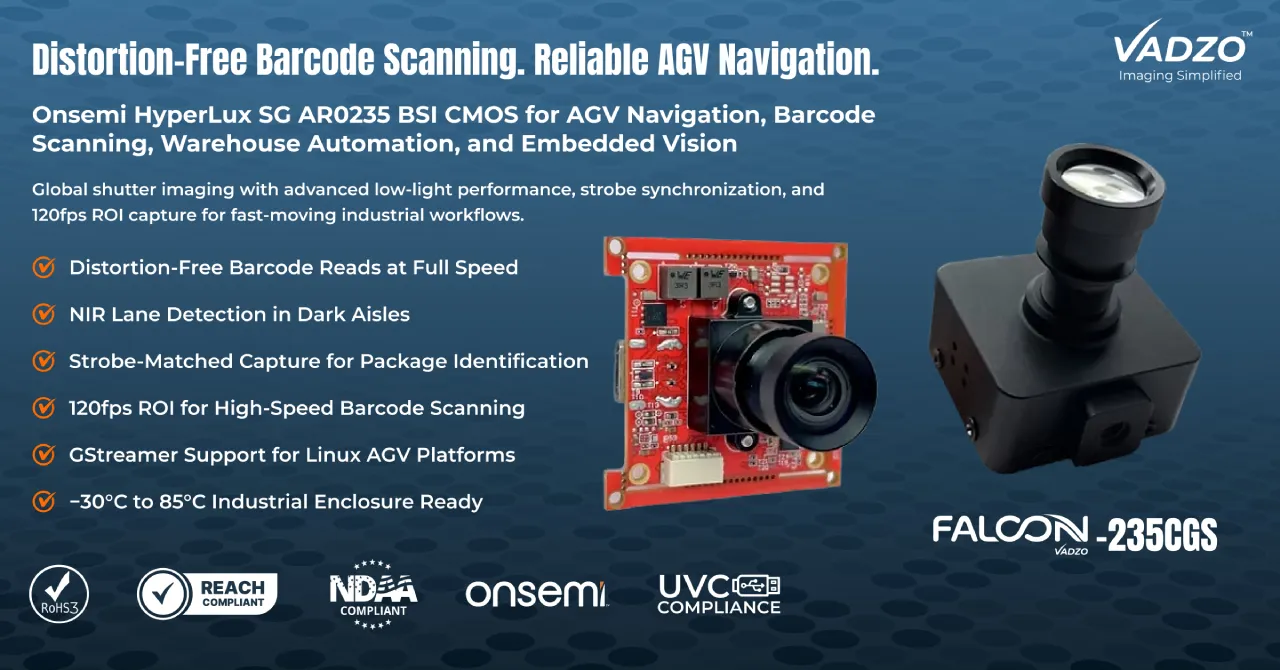
Sensor and Camera Overview
The AR0235 HyperLux SG is a 2MP (1920 x 1200) color sensor on a 1/2.6-inch optical format, built on onsemi’s backside-illuminated CMOS image sensor architecture with a 3.0 µm pixel pitch. Backside illumination places metal interconnects behind the photodiode layer, increasing fill factor and delivering signal-to-noise ratio enhancement over frontside-illuminated equivalents. Simultaneous pixel exposure across the full array means every row captures the same instant, so barcode labels and floor path markings on a moving AGV platform arrive as geometrically accurate frames without the distortion a rolling shutter introduces at speed.
An on-chip Image Signal Processor handles demosaicing, white balance, and auto exposure per frame, supporting real-time image acquisition without loading those tasks onto the host SoC. The AR0235 Color 2MP Global Shutter USB 3.0 Camera connects over USB 3.0 and outputs UVC-compliant video recognized natively on Linux, Windows, and Android. Validated from −30°C to 85°C, the camera covers cold-storage logistics zones and ambient warehouse floors within the same hardware build. Hardware trigger and GPIO support deterministic synchronization with IR illuminators and induction-loop triggers.
Key specs: 2MP (1920 x 1200) | onsemi AR0235 HyperLux SG | 1/2.6″ BSI CMOS | Global Shutter | Up to 60fps full frame / 120fps windowed ROI | USB 3.0 / UVC | NIR + HDR | Hardware Trigger + GPIO | −30°C to 85°C | Linux / Windows / Android
Key Capabilities of the AR0235 HyperLux SG AGV Lane Detection Camera
Global shutter pixel architecture for simultaneous pixel exposure. Rolling shutter sensors read the array line by line at a fixed rate. When a barcode label or floor guidance marking moves across the frame during readout, each row captures a slightly different position, producing geometric distortion that degrades OCR decode accuracy and lane detection reliability. The AR0235 HyperLux SG global shutter pixel architecture exposes every pixel at the same instant. Barcode geometry stays correct at full AGV traverse speed, and floor markings arrive without the lateral shift that causes guidance errors at cornering speeds or across uneven warehouse floors.
Silicon-level NIR enhancement and low parasitic light sensitivity. Warehouse aisles operate under uneven illumination: fluorescent fixtures over main lanes, deep rack shadow in storage zones, and complete darkness in automated dark-store sections. Silicon-level NIR enhancement in the AR0235’s backside-illuminated photodiodes extends sensor response to 850nm, enabling reliable floor path tracking when paired with active IR illuminators. Low parasitic light sensitivity suppresses stray signal from adjacent lit zones, keeping lane detection consistent across the full facility layout without per-zone exposure recalibration.
Active NIR-LED illumination strobe matching. Ambient fluorescent lighting introduces broadband interference that reduces label contrast on glossy barcode surfaces and retroreflective floor tape. Hardware trigger on the 120 FPS Global Shutter Camera synchronizes the exposure to an active NIR-LED illumination strobe in windowed ROI mode, so each frame is lit only by the controlled IR source. Package identification rates on mixed-label SKUs hold steady across varying overhead lighting conditions because the sensor captures only the strobed illumination, not ambient interference.
Image Signal Processor and real-time image acquisition. The on-chip Image Signal Processor performs per-frame demosaicing, white balance correction, and auto exposure without host-side processing. That offload sustains real-time image acquisition at 60fps full frame, with windowed ROI reaching 120fps, fast enough to resolve barcode labels at the traverse speeds pick-and-place AGVs operate. The ISP manages exposure transitions between directly lit main aisles and dark rack shadow automatically, removing the need for host-side gain intervention between zones.
Signal-to-noise ratio enhancement from backside illumination. The AR0235’s backside-illuminated CMOS design increases photodiode fill factor by relocating metal interconnect layers behind the light-sensitive area. This signal-to-noise ratio enhancement keeps route guidance and inventory automation reliable in low-intensity lighting, including night-shift warehouse runs and refrigerated logistics automation zones where illumination falls below the threshold that frontside-illuminated sensors handle without a gain penalty.
GStreamer pipelines and embedded vision integration. The camera’s UVC output works directly with GStreamer pipelines via V4L2 capture without additional middleware or SDK installation. AGV software stacks running ROS 2 or custom Linux frameworks pull frames into the embedded vision processing pipeline at full rate. The 2MP Global Shutter USB 3 Camera bare-board form factor keeps cabling and connector count minimal on mobile platforms where mechanical integration is constrained.
The AR0235 HyperLux SG is known for global shutter precision and silicon-level NIR enhancement. Most cameras at this level still skew barcode reads and lose lane detection in dark aisles. The AR0235 HyperLux SG resolves both. We built this AR0235 Color 2MP Global Shutter USB 3.0 Camera with NIR-LED strobe matching and GStreamer pipeline support. AGV and logistics teams get accurate barcode reads and reliable floor path tracking. One USB 3.0 UVC connection removes driver work on any Linux platform. That is what gets warehouse automation into production. – Alwin Vincent, Product Manager, Vadzo Imaging.
Applications Across AGV and Warehouse Vision Deployments
AGV Navigation and Lane Detection: Global Shutter Capture for Floor Marking Integrity at Traverse Speed
AGV guidance systems following floor tape, QR code grids, or magnetic strip layouts depend on per-frame camera output to maintain path registration continuously at operational speed. Rolling shutter sensors introduce row-dependent positional offset during frame readout that causes the floor marking boundary to appear at a different lateral position in the top rows versus the bottom rows of the captured frame. The CMOS image sensor architecture of the AR0235 HyperLux SG uses global shutter pixel architecture with simultaneous pixel exposure across the full array, so the floor marking position is geometrically consistent regardless of AGV speed, direction change, or floor surface variation. The AR0235 Global Shutter USB Camera delivers lane detection and AGV navigation accuracy from a sensor design that eliminates readout-induced distortion at the hardware level. The lane detection algorithm receives accurate path geometry from the sensor, not a distorted approximation that requires software correction.
Barcode Scanning and Package Identification: Strobe-Matched NIR Illumination for First-Pass Decode Accuracy
Pick-and-place robots and conveyor-side scan stations operate at AGV traverse speeds where the barcode label crosses the camera field of view in a fraction of the frame period. On mixed-SKU logistics lines where labels include glossy, matte, and partially damaged surfaces, ambient fluorescent overhead lighting introduces broadband interference that degrades label contrast at the sensor, and low parasitic light sensitivity in the AR0235’s BSI photodiodes suppresses stray signal from adjacent lit zones during capture. Active NIR-LED illumination strobe matching via hardware trigger limits each frame’s illumination to the controlled IR source, eliminating fluorescent interference from the barcode scanning image. The 120 FPS Global Shutter Camera in windowed ROI mode sustains first-pass decode rates for package identification across the full operating shift without pipeline adjustment for label type or surface condition.
Warehouse Automation and Inventory Automation: Single Camera Stream for Navigation and Item Identification
Warehouse automation deployments that use separate cameras for navigation and inventory scanning require the AGV host compute to manage two capture pipelines, two driver instances, and two synchronization domains simultaneously, which increases SoC resource consumption and introduces scheduling complexity in real-time operating environments. Inventory automation systems that scan shelf labels from multiple approach angles as the AGV passes need consistent frame quality across distances and angles that vary between aisle types and rack configurations. The on-chip Image Signal Processor manages per-frame demosaicing, white balance, and auto exposure for real-time image acquisition without host-side processing load, keeping the embedded vision pipeline on the AGV compute platform lean. The AR0235 Color 2MP Global Shutter USB 3.0 Camera delivers both navigation and inventory data over a single USB 3.0 UVC connection. The host pipeline runs one capture source, one driver instance, and one synchronization domain for both tasks.
Logistics Automation and Route Guidance: Sustained Floor Marking Reads Across Cold-Storage and Ambient Zones
Distribution centre AGVs cover routes between pick stations, dock doors, buffer zones, and cold-storage sections across operating shifts that run without interruption. Route guidance accuracy depends on the camera maintaining reliable floor marking reads through the complete route, including transitions between ambient-temperature warehouse floors and cold-storage sections that operate at −20°C or below. The AR0235’s backside-illuminated design delivers signal-to-noise ratio enhancement that keeps route guidance reliable in low-intensity lighting across refrigerated logistics automation zones without requiring gain amplification that introduces read noise. The 2MP Global Shutter USB 3 Camera ships as a bare-board camera module suited to compact AGV chassis where PCB footprint and mass budget are constrained, operating within the same −30°C to 85°C validated range across the full facility without hardware substitution at zone boundaries.
Floor Path Tracking in Variable Lighting: NIR Illuminator Synchronization for 24-Hour Operation
Facilities running 24-hour operations cycle between natural daylight through skylights, artificial fluorescent lighting during standard shifts, and reduced or absent overhead lighting during night-shift automated runs. Silicon-level NIR enhancement in the AR0235’s backside-illuminated photodiodes extends sensor response to 850nm, keeping floor path tracking reliable through all lighting transitions when paired with an active IR illuminator. AGV software stacks built on ROS 2 or custom Linux frameworks access the AGV Lane Detection Camera through GStreamer pipelines via V4L2 capture without additional middleware, integrating into the processing pipeline at full rate across every lighting condition the facility cycles through. The AGV maintains lane detection through shift changes, lighting transitions, and dark-zone sections without host-side intervention.
Frequently Asked Questions (FAQs)
1. How does the AR0235 HyperLux SG accelerate AGV lane detection and barcode scanning deployments?
AGV lane detection and barcode scanning place simultaneous demands on the camera: geometrically accurate floor marking capture at traverse speed, consistent barcode readout on labels that may be glossy or partially damaged, and sustained image quality in warehouse aisles where ambient light is uneven or absent. Meeting any one of these with a rolling shutter sensor requires post-processing compensation that adds pipeline latency and reduces throughput. The AR0235 HyperLux SG addresses all three at the sensor level: global shutter pixel architecture eliminates readout-induced distortion at any AGV speed, silicon-level NIR enhancement extends floor tracking into dark aisle sections, and active NIR-LED illumination strobe matching via hardware trigger keeps barcode contrast consistent under overhead fluorescent interference. The integration engineer gets a camera that handles lane detection and barcode scanning on one USB 3.0 connection without post-processing to compensate for sensor architecture limitations.
2. Why is the AR0235 a suitable camera module for low-light warehouse navigation systems?
Warehouse and distribution centre aisles present a lighting environment that standard cameras are not designed for: fluorescent fixtures over main lanes, deep rack shadow in storage zones, and complete darkness in automated dark-store sections. A camera without NIR capability requires supplemental visible lighting infrastructure to maintain floor marking contrast in these sections, which adds system cost and is not always permitted in facilities running mixed human-robot operations. The AR0235 HyperLux SG uses silicon-level NIR enhancement in its backside-illuminated photodiodes to extend sensor response to 850nm, enabling reliable floor path tracking when paired with 850nm IR illuminators. Low parasitic light sensitivity prevents stray signal from adjacent lit zones from degrading lane detection accuracy across the full facility layout. The AGV navigates through dark aisle sections without requiring host-side exposure intervention or supplemental visible lighting.
3. How does the AR0235 reduce rolling shutter distortion in high-speed AGV barcode scanning pipelines?
A rolling shutter sensor reads pixel rows sequentially from top to bottom of the frame. On an AGV moving at traverse speed, a barcode label crossing the frame during readout is captured at a different horizontal position in each row, producing geometric skew that OCR engines decode at reduced first-pass accuracy. At typical AGV operating speeds, this skew is measurable and consistent enough to degrade decode rates across an entire warehouse run. The AR0235 HyperLux SG uses global shutter pixel architecture to expose every pixel simultaneously in a single integration event, eliminating the row-dependent positional offset entirely. Barcode geometry is correct in every frame regardless of AGV speed, cornering angle, or label orientation. The OCR pipeline receives geometrically accurate input from the sensor without correction algorithms that add latency and reduce throughput.
4. What software support is included with the AR0235 platform-validated camera module?
Platform bring-up for a USB camera on an embedded Linux AGV system requires V4L2 driver loading, UVC device enumeration, and GStreamer pipeline configuration against the platform’s media framework. Without pre-validated support, the integration engineer resolves device tree conflicts, USB bandwidth allocation, and V4L2 format negotiation before getting a working video stream. The AR0235 HyperLux SG outputs UVC-compliant video over USB 3.0, recognized natively by Linux via the standard UVC kernel driver without proprietary installation. Vadzo provides GStreamer pipeline documentation, V4L2 format configuration for full 2MP and windowed ROI modes, and hardware trigger integration guidance for illuminator synchronization. The integration engineer connects the module, opens the V4L2 device node, and gets a working stream. The bring-up task becomes a connection step, not a driver development project.
5. How does the AR0235 simplify GStreamer pipeline integration on embedded Linux AGV platforms?
GStreamer pipeline integration on a Linux AGV platform requires the camera to expose a V4L2 device node, negotiate a supported format via VIDIOC_S_FMT, and deliver frames through a v4l2src element into the downstream processing graph. A camera with a proprietary capture interface requires a custom GStreamer source element or a middleware layer that adds latency and maintenance overhead to the AGV software stack. The AR0235 HyperLux SG outputs UVC-compliant video over USB 3.0, which Linux exposes as a standard V4L2 device node accessible to v4l2src without additional plugins. ROS 2 stacks using usb_cam or v4l2_camera nodes capture frames at full rate under the same interface. Vadzo provides pipeline documentation for common AGV deployment patterns, including barcode scanning, ROI capture, and lane detection full-frame streaming. The integration engineer builds the GStreamer graph against a standard interface, not a proprietary one.
6. What integration resources are available for the AR0235 camera module on supported AGV platforms?
Vadzo’s AR0235 HyperLux SG integration package includes UVC driver bring-up documentation for Linux-based AGV platforms, GStreamer pipeline configuration for full 2MP and windowed ROI capture modes, hardware trigger and GPIO wiring documentation for active NIR-LED illuminator synchronization, V4L2 format configuration files for barcode scanning and lane detection pipeline patterns, and lens selection guidance for standard AGV working distances. Operating range validation documentation covers the −30°C to 85°C range for cold-storage and ambient warehouse enclosure deployments. For OEM production deployments, evaluation kits include the bare-board camera module, USB 3.0 cable, and full integration documentation with no minimum order requirement.
Availability
The AR0235 HyperLux SG AGV lane detection camera is available now for OEM evaluation and production orders. Evaluation kits include the bare-board camera module, USB 3.0 cable, and integration documentation for Linux-based AGV platforms. There is no minimum order requirement. For volume pricing, OEM customization, and firmware configuration, browse the portfolio at https://www.vadzoimaging.com/, email support@vadzoimaging.com.
About Vadzo Imaging
Vadzo Imaging is one of the few companies worldwide that designs and manufactures embedded vision systems and camera modules, delivering premium imaging products at accessible prices for OEMs and system integrators worldwide. The company builds imaging platforms across USB, MIPI, GigE, Wi-Fi, and SerDes interfaces, supporting applications in industrial automation, robotics, smart surveillance, smart city infrastructure, and edge AI. Beyond hardware, Vadzo provides end-to-end imaging expertise, including sensor integration, ISP tuning, firmware development, and OEM customization services that accelerate development and deployment at scale. Every product is built on the principle that world-class imaging performance, designed and manufactured in India, should be accessible, reliable, and instantly deployable anywhere in the world. Visit vadzoimaging.com to explore the full camera portfolio.
Media Contact
Alwin Vincent
Vadzo Imaging
Email: alwin@vadzoimaging.com
LinkedIn: Vadzo Imaging
YouTube: Vadzo Imaging
X: Vadzo Imaging
SOURCE: Vadzo Imaging
View the original press release on ACCESS Newswire


