

Key Takeaways
- Open Lab is reserved, self-guided science — 30+ experiments across 6 stations that a family runs together, with lab coats and safety glasses included.
- An hour is the natural visit. Most families get through 3-5 experiments, and slots are reserved online before arriving.
- The adult stays and participates, and that’s a feature — family science time counts as real learning.
- It’s the founding offering of Little Beakers, built so any family could afford one inspiring hour with no commitment.
- Pay-per-visit comes first. Membership comes when the kids start asking to go back.
The Program Families Ask About Most
Open Lab is the simplest thing Little Beakers does — and the thing families come back for most. A family reserves a slot, shows up, and works through real, hands-on science experiments together, at its own pace. No enrollment. No semester. No stage with a presenter. That’s also why the program owner, Trevor Morgan, gets asked about more than anyone else, and why he wrote the full parent’s guide to Open Lab. The short version is below: how a first visit works, what kids actually do at the stations, and when Open Lab is the right call versus a party, camp or class.
Why It Exists
Little Beakers started on one conviction. Founder Dr. Cinttya Morgan, a military and aerospace polymers chemist, learned science from chemistry sets at her mom’s kitchen table, and she built the lab so any family could walk in — even for just one hour — and let a child use real equipment and get inspired. No big commitment standing between a curious kid and a lab bench. That’s Open Lab, and the Little Beakers story explains where it came from.
It’s also why so many families come in. An hour of science is an outing any family can say yes to, just like the park or the library. Except here, the library fizzes.
How a First Visit Works, Step by Step
Reserve a slot. Hours vary week to week, and on a given day the lab may be hosting a 100+ student field trip. Booking online — or at least calling 1-833-KIDS-LAB (1-833-543-7522) ahead — is the way in. The lab is flexible on exact start times.
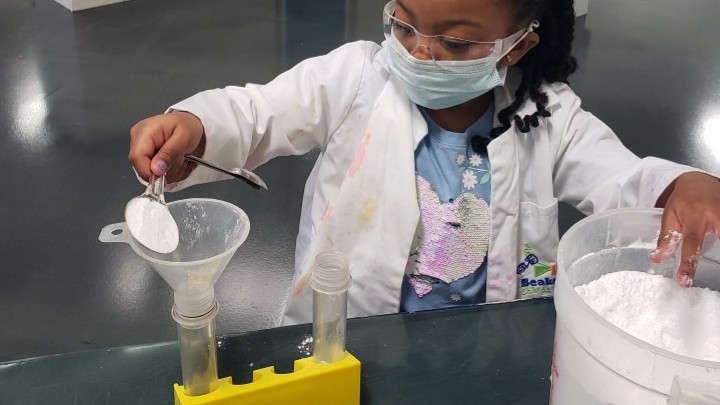
Gear up. Lab coats and safety glasses are provided, sized down to the smallest scientists.
Choose the experiments. Each of the 30+ experiments comes with instructions and materials ready to go. Follow the procedure, gather the materials, run the experiment.
Go at the kid’s pace. Most families run about 3-5 experiments in an hour — but blazing through ten and spending the whole visit perfecting one are both doing it right.
Come back. Experiments rotate, so returning families keep finding new science.
Two mix-ups worth clearing up early. Open Lab is not a drop-off — that’s Parents’ Night Out, and here an adult stays and participates. And it’s not a class either. Nobody leads a lesson; the family sets the pace and the playlist. Morgan calls it “the self-serve aisle of the lab, deliberately.”
What Kids Actually Do at the Stations
Real experiments, kid-run — mixing reactions with real labware, building circuits, testing magnets, making polymers, bending light. The mix spans chemistry, physics and biology, and the stations scale: the same bench runs simpler for a 4-year-old and deeper for a 14-year-old. “30+ experiments” is just a number until a family is standing at the bench, so here’s what the stations feel like.
Reactions. The crowd-pleasers — acid-base chemistry, color changes, fizzes and foams, all with real measuring. Most first-timers start here, because the payoff is immediate and repeatable.
Build-and-test. Physics kids assemble themselves: circuits, magnets, structures. These reward the kid who wants to modify the design and run it again, which is engineering practice without anyone using the word.
Materials and polymers. Slime’s serious cousins. Kids make a substance, then investigate the properties of the thing they made — a big one-two for a seven-year-old. And the creations go home with them.
Optics and perception. Light-bending, lenses, illusions. The quiet corner of the lab, good for the kid who needs lower stimulation and for the “one more experiment” wind-down before leaving.
Biology. Observation-first life science with microscopes and magnification. There are no specimens or dissections in Open Lab — families who get hooked on biology step up to the guided dissection classes.
The practical tip from the front desk: let the child pick the first experiment, then steer the second toward a station they skipped. Over a few visits, a map of the child’s interests starts to draw itself. The kid who always starts at reactions but lingers longest at circuits is saying something no aptitude quiz can.
The Adult’s Job (Fair Warning)
An adult stays with the kids and works through the experiments alongside them, and most parents end up elbow-deep. By Morgan’s count, half the parents get more into it than the children. That’s allowed — encouraged, honestly. Participation is the point, and it’s also how the learning happens.
The parent who “isn’t a science person” may be the most important adult in the room. When a kid watches a parent read unfamiliar instructions, try something, get it wrong and try again, that models more real science than a perfect demonstration ever could. Nobody needs to know the answers. The job is to sit at the bench and be willing to find out. The lab handles the rest.
Grandparents and caregivers take note, too. Open Lab may be one of the best grandparent outings around — seated-friendly, weather-proof, one hour. And it produces the thing grandparents want most: a shared story about the polymer they made together that would never have been allowed at home.
First-Visit Tips From the Front Desk
Plan on an hour of lab time — and don’t rush it. A session is one hour of actual lab time, with a few minutes of warm-up, and no family gets hurried off its last experiment. Most visits run a little over. The magic tends to start at experiment two.
Dress for science. Closed-toe shoes and clothes that can take a splash. The lab provides coats and glasses; sleeves are the family’s department.
Let the kid drive. The strongest visits are the ones where the adult resists curating. A child’s experiment choices are data.
Bring every kid. The 2-16 range is real. Siblings can work parallel stations at their own levels, which beats one bored sibling orbiting the engaged one.
Ask staff for the “one more” pick. The team knows which experiment converts skeptics.
Open Lab or Something Else?
Open Lab is the right choice for a first visit — the no-commitment answer to “will this kid even like this?” It also fits rainy days, school breaks, nothing-to-do afternoons, and homeschool families adding hands-on time to the week. A regular family outing that doesn’t cost a fortune, basically.
Something else fits better for a birthday (a scientist-led party with a private room), when a kid wants a week-long deep dive on one theme (camp), or when the family wants weekly structured instruction—that’s what the lab’s science classes are for. An evening off for the parents is Parents’ Night Out, the drop-off version.
The Membership Math
Here’s the honest framework, without quoting prices that change.
Visits one and two: pay-per-visit. The family is still finding out whether the lab is a hit. Never buy a membership on a first visit — enthusiasm at the register is not data. Two visits is data.
The signal to watch for: unprompted requests. When the back seat starts asking, unprompted, when the next lab day is, a habit is forming — and habits are what memberships price for.
The comparison to run: realistic monthly visits times the per-visit cost, set against the membership rate at the local lab. Most families who visit even a couple of times a month find the membership flips the math. The mindset flips with it. The daily debate about spending money on a visit disappears, because the lab already feels like theirs. The families who get the most out of the lab are the ones for whom Tuesday-after-school-lab just became a thing that happens. Current options live on the Open Lab and memberships page.
Why One Hour Is Enough to Matter
The science backs the design. The National Academies’ report Learning Science in Informal Environments found that real science learning happens in exactly these settings — science centers, family activity, everyday experience — and not only in classrooms. A 2024 study of preschoolers published through ERIC found that hands-on activity measurably builds science motivation even at that age. One self-guided family hour sits right where both findings meet. The bigger case for learning by doing is in the Little Beakers complete guide to hands-on science for kids.
Where to Go
Open Lab runs at all five Little Beakers locations — Cypress, The Woodlands and Katy/Memorial around Houston, and Sandy and Orem in Utah. Hours vary by location and season, so check the local schedule and reserve a slot first.
One hour tells a family whether it has a chemistry kid, a circuits kid, a materials-and-polymers kid — or a kid who just had a great Saturday, which also counts. Families say the ride home is the tell. When the “what happens if…?” questions start before the car leaves the parking lot, the visit did its job.
About the author: Trevor Morgan owns Little Beakers Science Lab for Kids, based in Cypress, Texas, and has run the company’s day-to-day operations since 2011. He has personally watched countless parents claim they were “just supervising”—right up until they took over the volcano experiment.
Little Beakers Science Lab for Kids
1-833-543-7522
13040 Louetta Rd
Ste 226
Houston
Texas
77429
United States