GA, UNITED STATES, September 22, 2026 /EINPresswire.com/ — Bacterial motility is fundamental to niche exploration, competitive fitness, and host infection. Flagella and type IV pili (T4P) are the two common motility apparatuses in bacteria, mediating swimming in liquids and swarming or twitching on solid surfaces, respectively. Xanthomonas campestris pv. campestris (Xcc), a phytopathogen of cruciferous plants, possesses both a polar flagellum and T4P, serving as a model for studying plant–microbe interactions. However, the regulatory mechanisms governing Xcc motility and their roles in host colonization remain elusive. Here, the authors show that DrdR, a tandem receiver domain response regulator, is activated following host contact and interacts with PilB/PilT to enhance ATPase activity, driving T4P-mediated swarming. This process promotes bacterial colonization of leaf hydathodes during early infection and contributes to virulence.
Bacterial motility is critical for niche exploration, competitive fitness, and host infection. Flagella and type IV pili (T4P) are two common motility systems in bacteria, mediating swimming in liquids and swarming or twitching on solid surfaces, respectively. Xanthomonas campestris pv. campestris (Xcc), an important phytopathogen within the genus Xanthomonas, possesses both a single polar flagellum and peritrichous T4P, making it a model organism for studying plant–microbe interactions. However, the regulatory mechanisms governing motility in xanthomonads and their contributions to host colonization remain poorly understood.
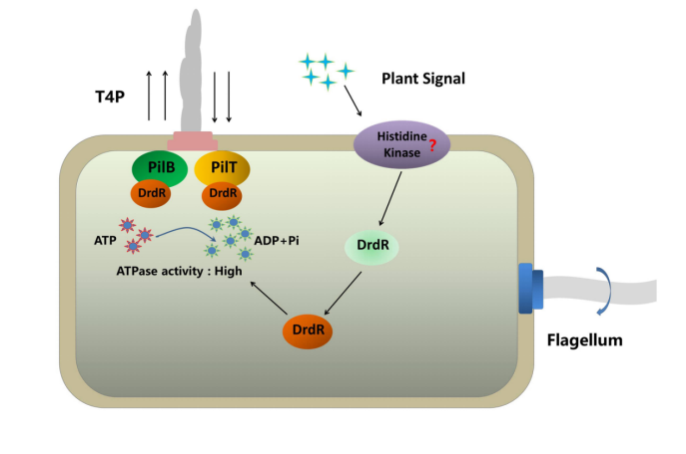
Although two-component system proteins containing tandem receiver domains are widespread in bacteria, their functions remain poorly understood. In this study, the authors characterized DrdR, a unique response regulator in Xcc that contains tandem receiver domains but lacks an output domain. They found that DrdR positively regulates swarming motility while negatively regulating swimming, modulates chemotactic responses to diverse attractants, and plays an important role during early infection. Co-immunoprecipitation and protein–protein interaction assays showed that DrdR physically interacts with the T4P motor proteins PilB and PilT. Enzymatic and genetic analyses further showed that DrdR enhances the ATPase activity of PilB/PilT to promote pilus extension and retraction, thereby controlling Xcc swarming. Bioinformatics analysis combined with site-directed mutagenesis indicated that one of the two REC domains in DrdR is a canonical functional receiver domain with an intact active pocket and conserved phosphorylation-site residues, whereas the other is a pseudo-receiver domain incapable of phospho-signal reception. Collectively, the authors proposed a working model in which, upon sensing plant-derived environmental signals, an as-yet-unidentified upstream histidine kinase activates DrdR. The subsequent increase in DrdR activity and abundance stimulates the ATPase activity of the pilus motor proteins, driving Xcc swarming on plant surfaces and ultimately enhancing bacterial colonization of leaf hydathodes.
DOI
10.1002/mlf2.70092
Original Source URL
https://doi.org/10.1002/mlf2.70092
Funding information
This work was supported by the National Natural Science Foundation of China (32160036 and 32360649) and the Natural Science Foundation of Guangxi Zhuang Autonomous Region of China (2023GXNSFAA026394).
Lucy Wang
BioDesign Research
email us here
Legal Disclaimer:
EIN Presswire provides this news content “as is” without warranty of any kind. We do not accept any responsibility or liability
for the accuracy, content, images, videos, licenses, completeness, legality, or reliability of the information contained in this
article. If you have any complaints or copyright issues related to this article, kindly contact the author above.

Media gallery