Only 65 percent of employers taking action on women’s health at work but progress remains fragmented, reveals Kearney
PR Newswire
LONDON, May 27, 2026
- Across industries, just 65 percent of employers have reached mature stages of action.
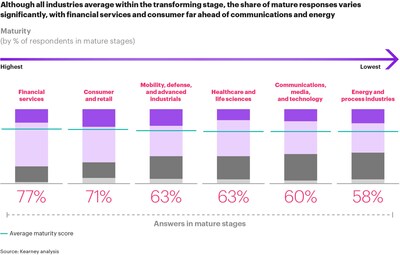
- Financial services ranks highest with 77 percent of organizations demonstrating this high maturity. Energy and process industries rank lowest at 58 percent.
- Only 51 percent of organizations provide sex- and gender-specific training and 54 percent track women’s health data.
LONDON, May 27, 2026 /PRNewswire/ — New analysis from global consultancy Kearney, developed with the UNFPA-led Equity 2030 Alliance and Healthcare Businesswomen’s Association, reveals critical gaps in workplace support for women’s health. While 65 percent of organizations are advancing women’s health support at work, many organizations still struggle to translate awareness into consistent, measurable action.
The findings come from Kearney’s latest [w]Health Employer Index, a benchmark assessing how organizations are embedding women’s health into workforce strategy, leadership, and operations across industries and regions.
Financial services leads while healthcare underperforms
With 65 percent of organizations making strong progress in addressing women’s health at work, the Index reveals sharp differences between sectors. Financial services ranks highest overall, with 77 percent of organizations demonstrating mature action on women’s health, followed by consumer and retail at 71 percent. Energy and process industries rank lowest at 58 percent. Notably, healthcare and life sciences, despite being closest to health innovation, continues to lag in key areas such as data accountability, communication, and inclusive culture (see figure).
Strong investment, weak accountability
Across sectors, employers perform strongest in benefits, well-being investment, and advocacy, but lag behind in education, communication, and employee voice. Only 51 percent provide robust sex- and gender-specific education and training and just 54 percent systematically monitor women’s health initiatives and collect gender-specific employee data to shape workplace policies and improvements.
The findings suggest many organizations still approach women’s health through isolated initiatives—such as maternity or reproductive benefits—rather than embedding it into workforce design, leadership accountability, and long-term business strategy.
To advocate for increased investments in women’s health in the workplace, Kearney joins UNFPA’s Coalition for Reproductive Justice in Business, a multistakeholder network of employers, entrepreneurs, and leaders who recognize that reproductive health care is a fundamental right, and that the business community has a role to play in defending it.
“Women spend more than 40 per cent of their reproductive years in the workplace, making their health a critical factor for their participation in the workforce. Private sector investment in sexual and reproductive health and rights — from menstrual health to parental leave — is a proven catalyst for reducing absenteeism and boosting productivity,” says Mariarosa Cutillo, UNFPA Private Sector and Civil Society Branch Chief.
Taking immediate action
The index highlights that the next phase of progress requires a decisive shift from awareness to accountability. Three priorities are essential for accelerating progress:
- Embed women’s health into workforce design.
- Strengthen gender-disaggregated data and KPIs.
- Align access, investment, and incentives to deliver consistent support across the workforce.
Paula Bellostas Muguerza, partner and global healthcare and life sciences lead at Kearney, said:
“Too many organizations are still treating women’s health as a side conversation, despite its direct impact on productivity. Employers cannot afford to ignore the reality that millions of women are navigating health challenges that affect their experience at work every single day.
“The companies making real progress are embedding women’s health into the DNA of workforce strategy, building stronger cultures, retaining critical talent, and creating healthier, higher-performing workforces.
About Kearney
For 100 years, Kearney has been a leading management consulting firm and trusted partner to three-quarters of the Fortune Global 500 and governments around the world. With a presence across more than 40 countries, our people make us who we are. We work impact first, tackling your toughest challenges with original thinking and a commitment to making change happen together. By your side, we deliver—value, results, impact. Learn more at www.kearney.com.
About the United Nations Population Fund (UNFPA)
UNFPA, United Nations Population Fund, is the sexual and reproductive health agency of the UN. It works to uphold the rights and choices of women, girls and young people across more than 150 countries. UNFPA’s The Equity 2030 Alliance is a global effort to normalize gender equity in science, technology and financing solutions by introducing data-driven arguments and strategies. UNFPA’s Coalition for Reproductive Justice in Business is a multistakeholder consortium of organizations advocating for, and committing to increased investments in sexual and reproductive health and rights policies in the workplace.
About the Healthcare Businesswomen’s Association (HBA) Think Tank
The HBA Think Tank is an award-winning, research-driven initiative that brings together senior leaders across the globe to shape the future of the healthcare workforce. With a focus on the Future of Work, the Think Tank identifies industry challenges such as wellness, talent readiness, digital transformation, and leadership advancement. Through global surveys, data-driven summits, and cross-industry collaboration, it generates innovative, evidence-based solutions that organizations can apply directly. By turning insights into action, the HBA Think Tank is driving measurable progress in workplace design, health outcomes, and sustainable workforce strategies across healthcare and life sciences.
hbanet.org/hbathinktank
About the [w]Health Index
Launched in 2024 at the World Economic Forum (WEF) in Davos, the [w]Health Index seeks to provide organizations with the frameworks, benchmarks, and data needed to guide effective actions that will close the gap in women’s health equity. The Index findings are based on the assessment and analysis of data from organizations across the pharma, MedTech, consumer health, payor, provider, and investment sectors. Structured surveys were combined with in-depth interviews across North America, Europe, and Asia Pacific to arrive at the [w]Health Index rankings. For more on the Index, please visit this page.
About the Kearney Health Institute
The Kearney Health Institute, part of the Kearney Foresight network, convenes leaders from healthcare, life sciences, and beyond to provide foresight and drive collective action that impacts health outcomes worldwide.
We translate foresight into action by applying a forward-looking lens across healthcare, life sciences, and adjacent sectors to address the forces reshaping global health. By advancing our global impact platforms, delivering strategic briefings for senior leaders, and partnering with leading organizations, we move beyond thought leadership to mobilize collective action on the most critical challenges shaping the future of health worldwide.
www.kearney.com/industry/health/health-institute
US press contact for Kearney:
Meir Kahtan
Meir Kahtan Public Relations
mkahtan@rcn.com | +1 917-864-0800
UK press contact for Kearney:
Tom Stewart-Walvin
Rostrum – PR consultants to Kearney
t.stewart-walvin@rostrum.agency | Kearney@rostrum.agency

 View original content to download multimedia:https://www.prnewswire.com/news-releases/only-65-percent-of-employers-taking-action-on-womens-health-at-work-but-progress-remains-fragmented-reveals-kearney-302780537.html
SOURCE Kearney